

Architecture of Grace™
When you become a mother, your brain, body, and nervous system go through a transformation as significant as adolescence. Researchers call it matrescence, and it happens by design. A 2016 brain-imaging study found measurable changes in the regions that support caregiving and attachment, changes that lasted for years afterward. Your nervous system enters a state of heightened alertness, nature's way of keeping you attuned to a completely helpless baby. That heightened state makes rest harder. Sleep lighter. Joy less accessible.
“Giving birth does not automatically make a mother out of a woman.”
Dana Raphael, Medical Anthropologist, who coined the term "matrescence" in 1973
Anxiety, rage, guilt, shame, overwhelm, depletion. These are common in early motherhood, far more common than most mothers are ever told. What's rare is saying so out loud. The world shows a different picture: calm, glowing, put-together. We compare ourselves to that image and find ourselves wanting. Guilt follows, then shame. We push harder and ask for less. A cycle that can only be broken through care.
“Depletion may be common—but it is not normal. And it is not inevitable.”
Dr. Oscar Serrallach, physician who named postnatal depletion, author of The Postnatal Depletion Cure
The yoga class you used to take twice a week. The nights out that let you laugh until you reset. The massage, the manicure, the long bath alone. These were how you regulated before. None of them are available in the same way now. And the occasional gesture, the spa day, the one morning off, does not regulate a nervous system. A nervous system needs consistency. When you become an on-demand caregiver for someone completely helpless, the need for self-care is greater than it's ever been.
Self-care is not indulgence. It is stewardship: the way you preserve your capacity to love well, to be present, to stay yourself through the years of holding another life. It does not have to be elaborate. It has to be consistent. The Architecture of Grace™ gives that consistency a structure that is manageable in small moments across the day. And it does not always mean away from the baby.
“Mums can feel overwhelmed, overworked, overstimulated, and over needed.”
Dr. Oscar Serrallach, The Postnatal Depletion Cure
The Architecture of Grace™ is the intentional structures, rituals, boundaries, support systems, and practices that protect a woman's softness while she carries responsibility, build her capacity over time, and help her cultivate a slow, connected, beautiful motherhood.
The architecture is the structure: the sequence, the repetition, the predictability. The grace is the outcome: the capacity to remain soft under pressure, present under depletion, steady under the weight of what you are carrying.
Grace does not happen accidentally. Grace emerges because structure exists. The architecture is what protects the softness. The repetition is what builds the capacity. Touch is what makes any of it reach you. Beauty is what catches your attention.

The moment you first hold your baby, something in you reorganizes too. This page is about that second, quieter beginning: yours.
Your own nervous system matters more now, because it isn't shaping only you anymore. Your baby's nervous system is still developing, and it learns by watching yours. When yours steadies, theirs follows.
The core belief we offer you: when a baby is born, a mother is born too. Becoming a great, loving, nurturing mother doesn't happen overnight. It's a process, and I am here to support it.
This first expression of the system is built for early motherhood. What you learn here will carry you through the other seasons of life still ahead.
The Architecture of Grace™ is the framework that makes that steadiness possible: giving your body something it can depend on, and supporting what you are already becoming, rather than asking more of you or trying to change who you are.
Capacity is the Goal
You hear it everywhere: manage your stress, practice self-care. But nobody explains what that actually means.
Many of us picture bubble baths and indulgent days off when we hear self-care. That can be part of it, but it's a small piece, for the rare day you have the time and the means. Real self-care looks different for every person, because what regulates one nervous system doesn't necessarily regulate another.
This is exactly what the Architecture of Grace™ builds: the skill of finding what actually works for you, through an architecture built around your own nervous system.
The goal is capacity: the ability to remain graceful while holding more. More than endurance, more than simply carrying on, capacity is the ability to stay playful, joyful, sensual, connected, and present while your responsibilities keep growing.
This is what every ritual is building, even when it feels like a single small moment of warmth, scent, and rest.
The mechanism is layered:
Beauty → Attention → Safety → Softening → Participation → Pleasure → Regulation → Capacity → Joy
Intentional Pleasure feels good now and increases capacity later. Warmth. Touch. Beauty. Aroma. Connection. Ritual.
Escapism feels good in the moment and reduces capacity over time. Scrolling. Numbing. Overconsumption. Avoidance. Dissociation.
Royal Heir focuses on pleasure practices that grow capacity.
Without architecture, softness becomes depletion. Generosity becomes martyrdom. Caregiving becomes self-erasure. Love becomes resentment.
With architecture, softness remains available. Generosity remains sustainable. Caregiving remains loving. Love remains warm.
Beauty as Regulation
Beauty in this system is not decorative. Beauty is regulatory.
When we are depleted, performing, self-monitoring, we fall into anxiety states like perfectionism or procrastination. Our attention is consumed by managing the appearance of motherhood. Beauty interrupts that. A beautifully made object catches your attention: a tin you enjoy holding, a serum with petals visible through the glass, a velvet pouch you run your fingers over before opening. It pulls you back into the present.
The gold leaf in the Rose Serum. The embossed tin. The floral petals. The velvet pouch. The architecture of the packaging. The unhurried voice of these words.
They function as awareness tools, designed to pull you out of the autopilot of survival mode and back into sensory presence, because awareness is the precondition for every other part of this work.
Researchers have found that the words we use to describe our own home, calling it cluttered or calling it restful, predict our cortisol levels the same day. What surrounds us is never neutral.
This is part of why Royal Heir keeps so few products, made to be shared between you and your baby instead of multiplied into five separate routines. Less on the counter means less pulling at your attention, and more capacity left over for what actually matters.
And as your capacity grows, awareness becomes intention. At first, a beautiful object is what catches your attention. Over time, you learn to do this for yourself: choosing your own rituals, acting from awareness and your immediate needs.

A mother and baby's hands touching
Touch is often the very first beauty either of you notices: a hand closing around a finger, skin against skin, before words, before understanding, already regulating both of you.
The Role and the Woman
Motherhood is a role. But we are more than a role.
We all know a mother who seems to have disappeared into motherhood and lost herself in it. When we become only what we do for others, resentment, bitterness, and withdrawal find us.
The Architecture of Grace™ keeps us connected to who we are beneath the role, so we can stay ourselves as we mother with presence and joy.
Sequence
The same steps, in the same order. Water, then oil, then touch. Your body begins to know what comes next. That predictability carries significance: it is how the nervous system learns to soften before the ritual is finished.
Repetition
What is repeated becomes familiar. What is familiar becomes safe. A ritual practised once is pleasant. A daily ritual signals safety and self-love to our body.
Presence
The ritual asks nothing of your attention. It works through sensation: temperature, scent, texture, touch. You do not have to be fully there for it to hold you. That is the design.
“A ritual practiced repeatedly quiets the brain's alarm response to failure, even without belief in the ritual itself.”
Research by Nicholas Hobson et al., PeerJ, 2017, building on Fiese et al.'s work on family ritual

Your nervous system does not stay in one state throughout the postpartum year. It shifts. The Architecture of Grace™ follows that rhythm.
In the earliest weeks, your body is raw and open. Scented care can be too stimulating. This is where we start with simple supportive formulas: warmth, texture, quiet contact with your skin do the holding at the start.
For some of us, the earliest weeks look different than we imagined: an incubator instead of a bassinet, a NICU instead of a nursery. The nervous system work is the same. It just starts sooner, and asks more of you.
There will be moments when you feel numb going through the motions on autopilot. You may not have words for what you're carrying, and that's alright. The system holds that too. It doesn't ask you to feel more than you have room for.
At other times, you'll feel touched-out, needing everything to go quiet. Those practices pull back instead of adding more. Some days, you'll feel flat, like you're watching your own day instead of living it. There are rituals for that too, ones that help you return to yourself.
The Architecture of Grace™ teaches you to listen to what your body is telling you, and to know what to reach for. So your softness can stay with you through the season.
The formula is the medium. The ritual is the method. Regulation is the outcome.
If you think this is about the skincare, you're wrong.
The skincare is a supportive neurosomatic tool, offering aromatic anchors: a pleasant, pleasurable experience for the skin that signals safety to our nervous system. Every Royal Heir formula is barrier-supportive, hormone-safe, nervous-system-aware, and designed for a body that is in a receptive state. The Rituals pages explain what each formula supports and why.
Touch More™ — The Practice
If the Architecture of Grace™ is the philosophy, Touch More™ is the practice.
Touch More is how the architecture is lived. It carries many meanings: physical touch, skin-to-skin connection, presence, comfort, ritual. And one underlying invitation: stay present, connected, available, human, soft.
The Touch More articles in our journal section are just a small part of what the full First Year of Motherhood holds. The weekly letters, written around your own year, are where the practice truly arrives. They accompany you, week by week, across the year.
The First Year of Motherhood
This is the guided year built on everything above: weekly letters, individualized care, and a system that learns about you as your year unfolds.

A gift with lasting effect.
She is carrying more than most people see. Most gifts are intended for the baby. This one is for both.
Touch is the Pathway
“New moms need as much loving touch as they are offering.”
Kimberly Ann Johnson, The Fourth Trimester
When you're depleted, thinking clearly is often the first thing to go. You can't always find the words for what's wrong, or think your way through it.
But touch still works. Your skin still feels the warmth of a familiar hand, the weight of your baby against your chest, long after your mind has stopped keeping up. That's what carries you through, on the days when nothing else does.
The progression:
Touch More → Feel More → Trust More
“Touch reaches the nervous system through pathways that stay open even when the thinking mind is overwhelmed.”
Research from the Touch Research Institute, University of Miami (Hernandez-Reif & Field)
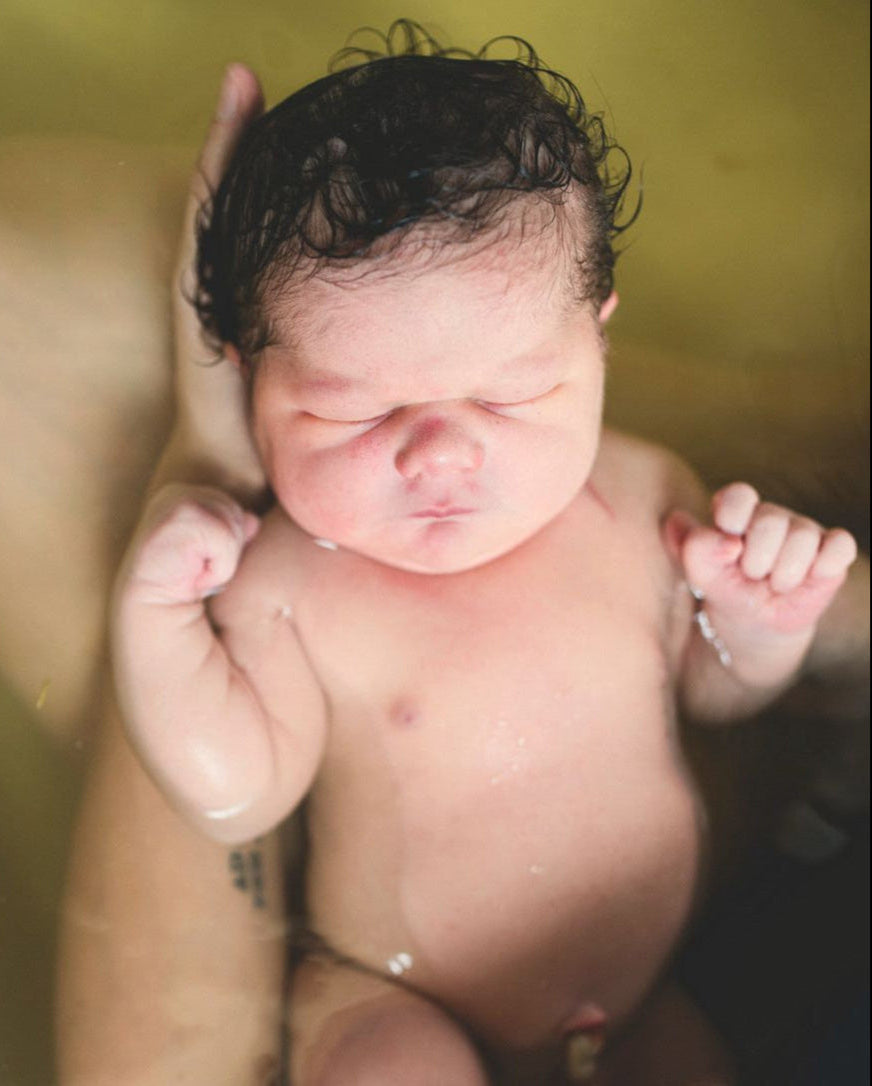
Every touch, your own hands during the ritual, your baby's body against yours, warm water, the texture of butter, brings you back into your body through pleasure practices. Feeling returns, and once you're sensing your body again, you can trust what you feel.
What the architecture does is preserve your connection to yourself when support is limited. And it reminds you, in the quietest way it can, that real support is worth asking for, again and again if you need to.
What the Architecture Cannot Replace
A ritual is not a partner. A bath is not a village. A serum is not a community.
The Architecture of Grace™ cannot replace real support. When you are undersupported, no ritual will make that right.
Maiden → Mother → Wise Woman
This system is ultimately preparing you to become a wise woman, past infancy, past toddlerhood, past the school years still ahead.
The ancient path: Maiden → Mother → Wise Woman.
Motherhood is the great expansion stage, where capacity is built, wisdom is earned, and self-cultivation becomes necessary.
Walk through this season cultivating your capacity with powerful and healthy tools, and you arrive at the other side as someone new, expanded by the initiation.
You are not lost. You are becoming.
And the child watching you cultivate your capacity learns something too: permission to take up space, to receive care, to remain themselves inside the roles they will eventually carry. The self-love you learn now changes the inheritance of the generations that follow.

I built this system after living through my own version of it.
I had my daughter later in life, almost 39, and perimenopause arrived not long after she did. I didn't have much support, so I had no choice but to find ways to regulate my own nervous system with her right there beside me, in the middle of everything, since a quiet moment alone never came.
I'm glad it happened that way now. She learned how to care for herself by watching me do it, hands-on, in real time, just by living beside it every day. She's a teenager now, steady in a way that still surprises me, someone who knows how to listen to her own body and take care of herself. We were doing all of it together, and it turned out to be good for both of us, not just for me.

Enrollment
Ready to begin your own Architecture of Grace?
The First Year of Motherhood is the guided, one-year expression of everything on this page: individualized rituals, weekly letters, and a system built around your own nervous system as it changes across the year.
Places open to a small number of mothers at a time. Join the Early Access Waitlist to hear first when they do.
The Architecture of Grace™ is expressed differently across each stage of early motherhood. The five ritual categories below are where that practice begins.